


How to Clear Your Study Backlog? Learn the Right Way-
Table of Contents
Does it happen to you that while new lectures and chapters are being completed, old topics remain unfinished? Sometimes it takes a long time to understand a difficult chapter, or sometimes school, coaching, or other reasons disrupt your study routine. Consequently, most students are unable to complete some chapters or topics on time. Initially, they dismiss one or two unfinished topics as normal, but gradually this problem grows into a study backlog. After this, completing old chapters along with new lectures and regular studies becomes challenging.
In fact, a major reason for the growing backlog can be a lack of proper planning and the constant postponement of difficult topics. In such a situation, the question that often arises in students’ minds is how to complete the backlog-that is, how to complete the unfinished chapters without disrupting their regular studies. But having a backlog does not mean that your preparation has gone bad or that it is no longer possible to complete the syllabus on time. So instead of panicking or taking pressure to finish the entire backlog at once, adopt the right strategy. Prioritize important topics and study regularly by making small study goals.
In this blog, we will learn how to complete the backlog; that is, what are the effective ways to clear the study backlog, how to manage the backlog along with current studies, and how to make a practical backlog study plan for yourself, so that you can gradually complete your incomplete chapters without any pressure and also maintain a balance with current studies.
Purpose of Blog-
The primary purpose of this blog is to help students learn how to complete their backlog in a systematic manner. Through this blog, students can learn how to prioritize unfinished chapters and topics, manage their backlog with current studies, and create a practical backlog study plan based on their abilities and available time. Furthermore, through this blog, students can better organize their studies by adopting effective techniques such as a daily study routine, revision, active recall, and question practice.
Helpful Resources-
If you want any kind of planner, you can find a variety of Planners on our other website, vijaybooks.store.
Another blog has been written similar to this blog.
What is a Study Backlog?

Backlog generally means any unfinished work that was not completed by the scheduled time and is still incomplete or pending. In the context of studies, backlog means that work related to a chapter, topic, or study task remains incomplete and is not completed by the scheduled time. When students, for some reason, are unable to complete their lecture, assignment, chapter, or question practice on time, the work becomes pending or postponed. This unfinished work is called a study backlog.
For example, a school student has two math chapters incomplete. A student preparing for a board exam may have missed some revisions or have two math chapters incomplete. This could be a backlog. Similarly, students preparing for NEET and JEE may have several lectures, physics numericals, chemistry concepts, or NCERT topics in biology incomplete.
Keep in mind that backlog isn’t limited to not completing lectures. After studying a topic, it’s also important to understand its concepts, solve questions, and revise periodically. If these tasks are incomplete, they should also be considered part of your study backlog.
Why Do Students Develop a Backlog?

There can be many reasons behind the development of a backlog in studies. Sometimes due to lack of time, or sometimes due to improper study planning, students are unable to achieve their set study goals. Some of the main reasons are as follows:
- Lack of a Regular Study Routine- Due to the lack of a fixed study time, chapters and topics remain incomplete.
- Procrastinating on Difficult Chapters- Most students leave difficult chapters for later, which increases their backlog.
- Setting Excessive Goals- Aiming to complete too many chapters in a single day increases study pressure.
- Lack of Balance between School and Coaching- Due to a lack of proper balance between classes, homework, and self-study, previously studied topics get left behind.
- Not Utilizing Time Wisely- Mobile phones, social media, and frequent interruptions increase the study backlog.
- Ignoring Revision and Practice- Focusing only on new topics leaves revision and question practice of already studied chapters incomplete.
- Taking More Time to Understand Concepts- Taking relatively more time to understand the concepts of a difficult chapter increases the study backlog.
Keep in mind, the reason for the backlog can be different for every student. Therefore, before clearing the backlog, it is important to understand the actual reason and make a study plan accordingly.
How Does a Growing Backlog Affect Studies?

Initially, leaving a few chapters unfinished may seem normal, but when the study backlog continues to grow, it can impact overall preparation. This problem becomes especially challenging for students during exams. Here are some of its major effects:
- Difficulty Understanding New Concepts- Incomplete chapters can make it difficult to understand new concepts related to previously studied ones.
- Possibility of Forgetting Previously Studied Concepts- Not revising for a long time can increase the chances of forgetting previously studied concepts.
- Lack of Time for Revision and Mock Tests- The longer it takes to complete the backlog, the more regular revision and test practice get affected.
- Increased Study Pressure- The increasing number of unfinished chapters can lead to stress and a lack of confidence.
- Lack of Complete Exam Preparation- Not completing the backlog on time increases the pressure of both syllabus and revision as the exam approaches.
- More Likely to Make Mistakes- In an effort to complete multiple chapters at once, not enough attention is paid to concepts and question practice, which can increase the chances of making more mistakes.
However, having a backlog is not a sign of failure. Studying can be reorganized by identifying your mistakes in time and adopting the right study plan.
What to Do Before Completing Your Backlog?
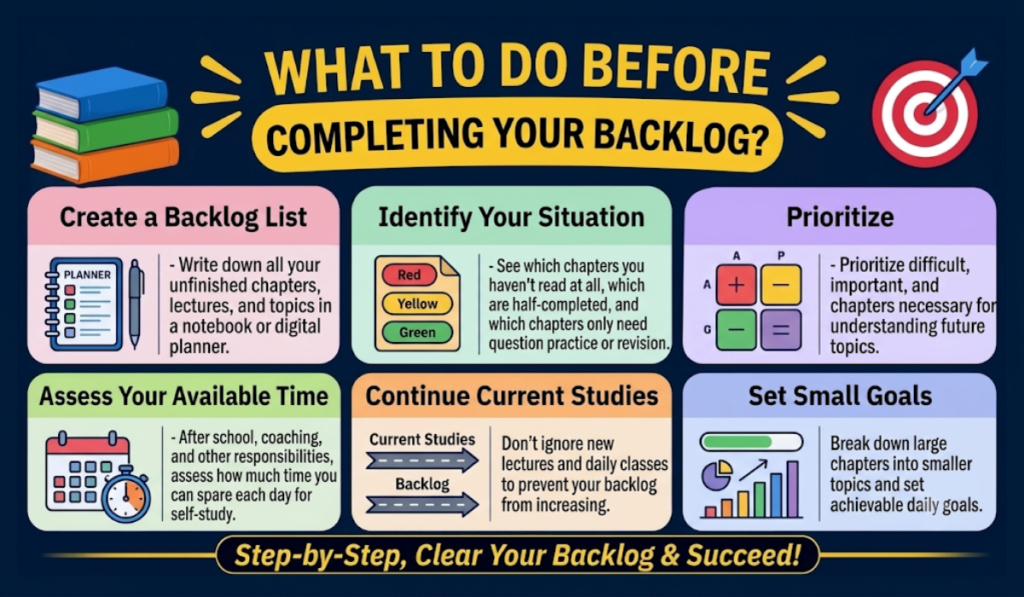
Completing your backlog shouldn’t be started without planning. It’s important to first understand how much of your syllabus is incomplete and how much time you can devote each day to completing it. With proper preparation, you can avoid unnecessary stress and make better use of your time. Before completing your backlog, do these things:
- Create a Backlog List- Write down all your unfinished chapters, lectures, and topics in a notebook or digital planner.
- Identify Your Situation- See which chapters you haven’t read at all, which are half-completed, and which chapters only need question practice or revision.
- Prioritize- Prioritize difficult, important, and chapters necessary for understanding future topics.
- Assess Your Available Time- After school, coaching, and other responsibilities, assess how much time you can spare each day for self-study.
- Continue Current Studies- Don’t ignore new lectures and daily classes to prevent your backlog from increasing.
- Set Small Goals- Break down large chapters into smaller topics and set achievable daily goals.
Example Backlog List-
| Subject | Pending Task | Current Status | Priority |
|---|---|---|---|
| Physics | Laws of Motion | Partially Completed | High |
| Chemistry | Chemical Bonding | Not Started | High |
| Biology | Cell: The Unit of Life | Revision Pending | Medium |
| Physics | Work, Energy and Power | Practice Pending | Medium |
You can create a list based on your needs. This will help you clearly understand what needs to be completed and which tasks to prioritize first.
How to Complete the Backlog: 7 Effective Ways-
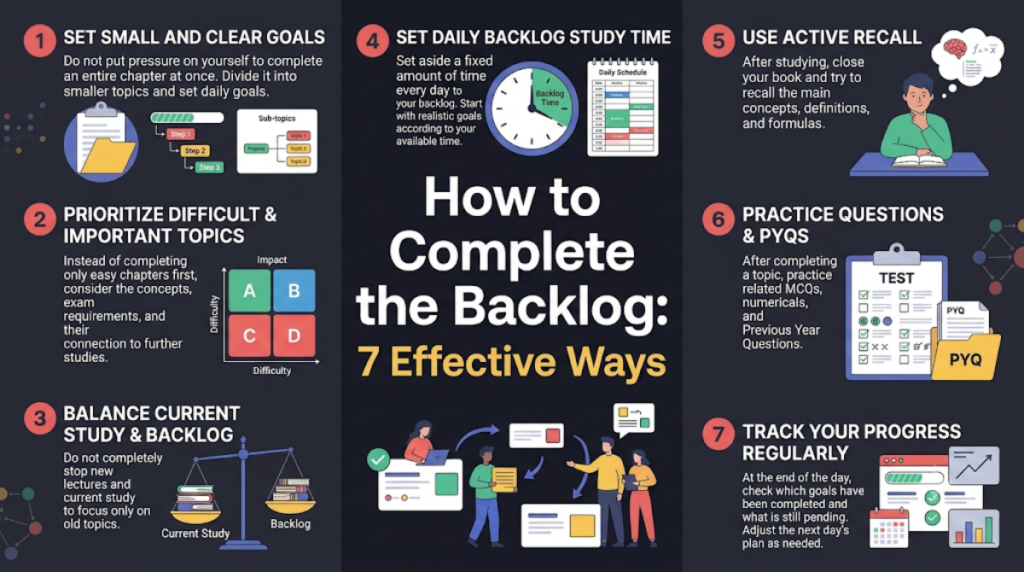
Studying for long periods of time isn’t enough to complete your backlog. A proper study strategy, efficient time utilization, and regular practice are also essential. If you want to systematically complete your unfinished chapters, you can adopt these 7 effective methods, which are listed below in table format.
| No. | Effective Methods | What to Do? |
|---|---|---|
| 1 | Set Small and Clear Goals | Do not put pressure on yourself to complete an entire chapter at once. Divide it into smaller topics and set daily goals. |
| 2 | Prioritize Difficult and Important Topics | Instead of completing only easy chapters first, consider the concepts, exam requirements, and their connection to further studies. |
| 3 | Balance Current Study and Backlog | Do not completely stop new lectures and current study to focus only on old topics. |
| 4 | Set Daily Backlog Study Time | Set aside a fixed amount of time every day to complete your backlog. Start with realistic goals according to your available time. |
| 5 | Use Active Recall | After studying, close your book and try to recall the main concepts, definitions, and formulas. |
| 6 | Practice Questions and Solve PYQs | After completing a topic, practice related MCQs, numericals, and Previous Year Questions. |
| 7 | Track Your Progress Regularly | At the end of the day, check which goals have been completed and what is still pending. Adjust the next day’s plan as needed. |
Remember, consistency is more important for completing the backlog. Adopt these seven methods according to your capacity and available time. Most importantly, do not ignore current study, revision, and question practice while completing the backlog. With regular efforts, you can gradually organize your studies.
Daily Study Timetable to Clear Backlog-
Creating a systematic daily study timetable can be helpful for clearing the backlog. This allows you to allocate time for current study, studying old chapters, and question practice. However, each student’s daily routine and study needs vary. Therefore, create a timetable that can be easily followed over a long period of time. Below is an example daily study timetable, which attempts to balance both regular study and backlog.
| Time | Study Activity | Objective |
|---|---|---|
| 6:00-7:00 AM | Difficult or Important Backlog Topic | Complete one important pending topic at the beginning of the day. |
| 7:00-7:30 AM | Quick Revision | Revise the concepts and formulas studied the previous day. |
| During the Day | School, Coaching, or Regular Classes | Keep up with new topics and lectures regularly. |
| 4:00-5:00 PM | Current Study | Complete the topics taught in class and update your class notes. |
| 5:00-6:00 PM | Backlog Lecture or Chapter | Complete a planned portion of an old pending lecture or chapter. |
| 6:00-6:30 PM | Break and Rest | Take some rest and prepare for the next study session. |
| 6:30-7:30 PM | MCQs, Numericals, and PYQs | Solve questions related to the current and backlog topics you have studied. |
| 8:30-9:00 PM | Revision and Active Recall | Try to recall the important concepts studied throughout the day without looking at your notes. |
| 9:00-9:15 PM | Daily Progress Review | Review completed study goals and plan the next day’s activities. |
How to Follow a Timetable Effectively?
- Complete Current Studies First- Give priority to regular classes and new topics to avoid creating a new backlog.
- Set Aside a Specific Time for Your Backlog- Dedicate 1-2 hours daily to old, unfinished topics, as per your convenience.
- Focus on One Topic at a Time- Break down large chapters into smaller parts and achieve a set goal each day.
- Don’t Skip Revision and Practice- After completing a chapter, be sure to solve the relevant MCQs, Numericals, and PYQs.
- Check Your Progress at the End of the Day- see which goals you completed and which ones you need to include in your next day’s plan.
Keep in mind that this timetable is just an example. You can modify it according to your school, coaching, travel, and other responsibilities. If your backlog is large, you may need additional time to complete it. So, instead of rushing, study regularly and keep updating your study plan according to your progress.
The best timetable is one you can follow regularly.
Why are Revision and Practice Essential for Completing Your Backlog?

Completing your backlog isn’t just about watching lectures or reading chapters. Regular revision and question practice are also essential for understanding a topic thoroughly and retaining it for a long time. If students continually read new chapters without practicing, they are more likely to forget previously learned concepts and formulas.
- For revision and practice, adopt study techniques like Active Recall and Spaced Revision. Active Recall involves closing the book and trying to recall previously learned concepts, definitions, and formulas. Spaced Revision involves revising previously studied topics at regular intervals.
- Additionally, after completing each topic, solve the relevant MCQs, Numericals, and PYQs. Write down questions you answer incorrectly or find difficult to solve in an Error Notebook. Practice these questions again after some time.
- When a chapter is completed, take a short self-test or chapter test to assess your preparation.
Remember, the real purpose of completing backlog is not just to finish previously unfinished chapters, but also to understand the concepts, remember them, and solve them correctly in the exam.
Practical Revision Schedule-
To remember the topics studied, you can follow the revision schedule given below.
| Revision Schedule | What to Do? |
|---|---|
| Same Day | Revise the main concepts and formulas of the previously studied topic. |
| Next Day | Recall important points without looking at your notes and solve MCQs. |
| After 3 Days | Revise the previously studied topic again and practice questions. |
| After 7 Days | Solve related PYQs and difficult questions. |
| After 15 Days | Do a quick revision of the topic and take a short self-test. |
| After 30 Days | Revise the entire chapter and assess your preparation. |
This is just an example, not a mandatory rule. Revise difficult topics as many times as required and include the concepts you have a good grasp of in the next revision cycle.
Practical Study Plan to Complete Your Backlog in 30 Days-
If your study backlog has grown and you’re unsure where to start, a systematic 30-day study plan can help. It breaks down your backlog into small steps and aims to complete them gradually. This can help reduce study pressure and keep up with current studies.
30-Day Backlog Completion Plan-
| Duration | Main Goals |
|---|---|
| Days 1-3 | Prepare a Backlog List and prioritize the chapters. |
| Days 4-10 | Complete the most important and pending topics. |
| Days 11-17 | Focus on the remaining important chapters. |
| Days 18-23 | Complete the remaining backlog and practice questions. |
| Days 24-27 | Revise previously studied topics and solve MCQs. |
| Days 28-30 | Take chapter tests, analyze mistakes, and complete any remaining tasks. |
Keep these Things in Mind When Following this Study Plan-
This study plan is only an example for students with a limited backlog. Completing all chapters is not guaranteed.
- If your backlog is large, you can extend this plan to 45, 60, or 90 days.
- Instead of focusing solely on completing your backlog, make time for new lectures and regular studies every day.
- If it takes longer to understand a topic, adjust your plan instead of rushing.
- Check your progress every week and set goals for the next week as needed.
Most importantly, don’t neglect current study, revision, and adequate rest in the rush to complete your backlog.
7 Common Mistakes When Completing Backlogs-

In an effort to clear backlogs, most students make certain mistakes that waste both their time and effort. For better results, avoid these mistakes and adopt practical solutions.
- Setting Too Many Reading Goals in One Day- Don’t plan to finish 3-4 large chapters at once. Set 2-3 small and clear study goals each day.
- Skipping New Topics- Don’t skip current lectures because of the backlog. Complete your regular studies first, then make time for the backlog.
- Reading Without Prioritization- List all unfinished chapters. Select important and difficult topics first, then sequence the remaining chapters.
- Watching Lectures Only- After the lecture is over, make notes and assess your understanding by solving 10-15 related questions.
- Procrastinating Revision- Set aside 15-30 minutes each day to revise old topics and create a revision schedule.
- Copying Others’ Timetables- Build a routine that you can follow regularly, keeping in mind your school, coaching, and self-study schedule.
- Abandoning Plans If Goals Are Not Accomplished- If a topic remains unfinished on a particular day, include it in the next day’s priority list. Change old goals as needed, but don’t break the continuity of your studies.
By adopting these small improvements, you can make better use of your time and prevent your study backlog from growing again.
5-Step Action Plan-
Simply identifying mistakes isn’t enough to clear your backlog. Start implementing these five steps today.
- Create a backlog list of all your unfinished chapters and topics.
- Select 2-3 important topics from this list for the next day.
- After your current studies, devote at least 1-2 hours to your backlog.
- Solve questions after each topic and revise previously studied topics.
- Check your progress at night and plan for the next day.
Start small, be consistent, and assess your progress weekly. This way, you will gradually reduce your backlog and manage your studies better.
What Should I Do Next to Avoid a Backlog?

Once you’ve completed your backlog, it’s crucial to maintain a regular schedule to avoid a new study backlog. Adopting a few small habits can be beneficial.
- Quick Revision- Revise topics covered in class or lecture for 15-20 minutes the same day.
- Complete Class Notes regularly- Don’t postpone unfinished chapters to the next day and keep important concepts organized.
- Daily Question Practice- Solve MCQs, numerical questions, or other questions related to the topics you’ve studied.
- Don’t Put Off Difficult Topics- If you’re having trouble understanding a concept, seek help from a teacher or classmate.
- Weekly Study Review- At the end of the week, review which topics have been completed and what remains.
- Plan for the Next Day- Set your study goals for the next day before going to bed.
Practical Daily Study Routine to Avoid Backlog-
To prevent a new backlog from forming even with regular study, you can follow the routine given below.
| Time | Activity | What to Do? |
|---|---|---|
| Immediately After Class (20 Minutes) | Quick Revision | Revise the topics taught in class today. |
| 4:00–5:00 PM | Current Study | Complete today’s lectures and pending chapters. |
| 5:00–5:30 PM | Class Notes | Organize your notes and understand difficult concepts. |
| 5:30–6:00 PM | Break | Take some rest and have a meal. |
| 6:00–7:00 PM | Question Practice | Solve MCQs and other questions related to the topics studied today. |
| 8:00–8:30 PM | Previous Revision | Revise old chapters and important formulas. |
| 8:30–8:40 PM | Next-Day Planning | Review pending tasks and write down the goals for the next day. |
To Make This Routine Effective-
- First, complete your current study and class notes. Then, practice questions and revise old chapters.
- If you have difficulty understanding a topic, write it in the pending list and try to understand it quickly.
- Make time for daily question practice.
- Once a week, review the week’s studies and pending topics.
- Make adequate sleep and rest a part of your routine.
- Finally, make time for planning for the next day.
This routine is just an example. It doesn’t set a specific time for backlogs, as its main objective is to complete today’s work today, preventing a new study backlog. You can adjust it according to your school, coaching, and other responsibilities, and shift your study time.
Regular study, timely revision, and adopting small study goals can reduce the likelihood of a new backlog.
Frequently Asked Questions (FAQs) about How to Complete the Backlog-

How to Complete Your Study Backlog?
First, make a list of all unfinished chapters and topics. Prioritize difficult and important topics. Set aside some time each day for your backlog and revise by solving questions after each topic.
Should you stop your current studies and complete your backlog?
No, it’s not right to completely stop your current studies. This creates a new backlog. Continue studying regularly and, in addition, set aside some time each day to complete old topics.
How many hours should you study your backlog daily?
This depends on your backlog and available time. Initially, you can set aside 1-2 hours per day for backlog study. You can increase or decrease the time as per your needs.
How to Complete Your Backlog in 1 Month?
First, make a list of all your backlog and prioritize the chapters. Divide the next 30 days into smaller goals and regularly study, practice questions, and revise. It can take longer to complete a large backlog.
How to complete your NEET and JEE backlog?
For NEET, focus on NCERT books for Biology, concepts for Chemistry, and numericals for Physics. For JEE, focus on concepts in Mathematics, Physics, and Chemistry, along with regular problem-solving. Practice PYQs and Mock Tests for both exams is also essential.
How to revise after completing your backlog?
After completing your backlog, practice active recall, chapter-wise revision, MCQs, and PYQs. Write down incorrect questions in your Error Notebook and revise them periodically.
Conclusion-

Having a study backlog isn’t uncommon, but constantly procrastinating can exacerbate the problem. So, instead of considering your backlog a huge challenge, try breaking it down into smaller study goals and completing them. Prioritize appropriately, create a practical daily study routine, and regularly engage in active recall, revision, and question practice.
Remember not to neglect current study in the pursuit of completing old chapters. It’s important to maintain a balance between the two to avoid creating a new backlog. Create a backlog study plan based on your study status, ability, and available time. With regular effort and the right direction, you can gradually streamline your studies.
If you found this blog helpful, be sure to bookmark or save it so you can read it again when needed. How much backlog do you have, and what strategies are you using to complete it? Share your experience in the comments below.