

Introduction: Why Don’t You Remember What You Read?
Table of Contents
Does it happen to you that you study for long periods of time, make good notes, and even solve important questions, but after a few days, when you try to recall the chapters you studied, you remember nothing and your mind goes blank? Sometimes it seems that you understood a chapter well yesterday, but today you can’t remember a single important point. This problem worsens as exams approach. In such a situation, students start wondering why they can’t remember what they studied despite so much hard work.

In fact, it’s not always due to a weak memory; rather, not revising at the right time after studying can also be a reason. Instead of simply reading notes over and over again, it’s better to try to remember the information you read without looking at the book, asking yourself questions, and reviewing the topics you studied at regular intervals. If you don’t revise regularly, you may have difficulty remembering previously learned information. But the good news is that this problem can be significantly reduced by adopting some simple and effective revision techniques.
In this blog, we’ll explore what revision techniques are, what methods should be adopted to retain what you study for a long time, and how to incorporate revision into your daily study routine to make your preparation more organized and effective.
Purpose of Blog-
The primary purpose of this blog is to educate students on easy, effective, and practical revision techniques that they can incorporate into their daily study routine. By adopting the right revision strategy, students can retain the information they have learned for a long time and organize their preparation better.
This blog explains in simple language the useful methods of Active Recall, Spaced Repetition, time management, subject-wise revision, and exam preparation. This technique helps students adopt the right revision technique as per their needs and make their preparation more effective and move forward towards achieving better results.
Helpful Resources-
If you want any kind of planner, you can find a variety of Planners on our other website, vijaybooks.store.
Another blog has been written similar to this blog.
What is a Revision Technique?
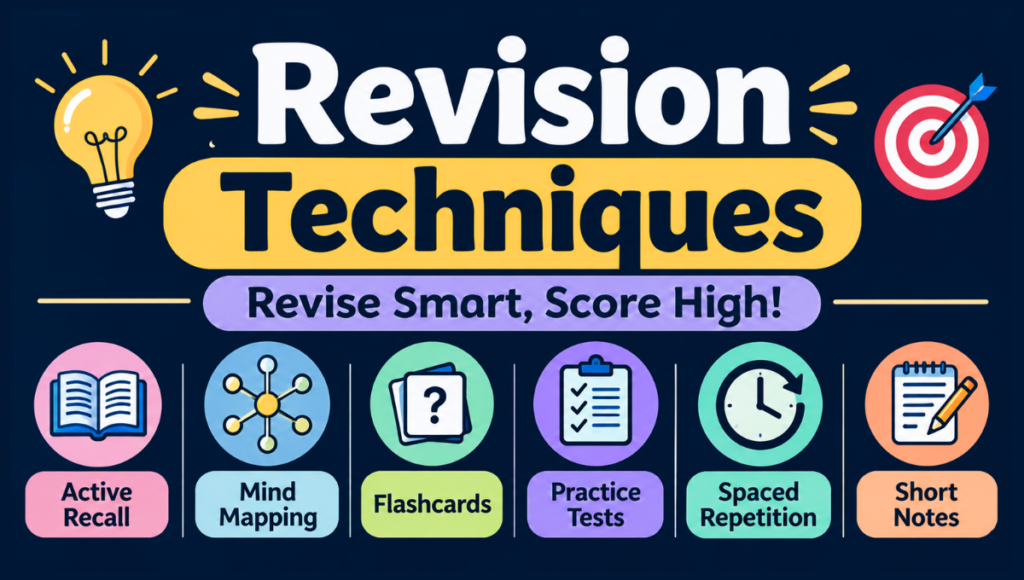
Revision technique means systematically reviewing, revising, and practicing memorization of previously studied topics, facts, formulas, and important information. Its primary purpose is to help students retain learned information for a long time and easily recall it when needed.
Most students understand revision as repeatedly reading a book or notes, but effective revision is slightly different. It involves trying to memorize a topic without looking at the book, asking themselves questions, writing down important answers, and solving practice problems. For example, if a student can explain key concepts without referring to notes after reading a chapter, this is a good revision practice.
Regular revision helps students understand which topics they have memorized well and which ones still need more practice. This provides an opportunity to improve weaknesses in a timely manner and organize their exam preparation.
Key Aspects of Revision Technique-
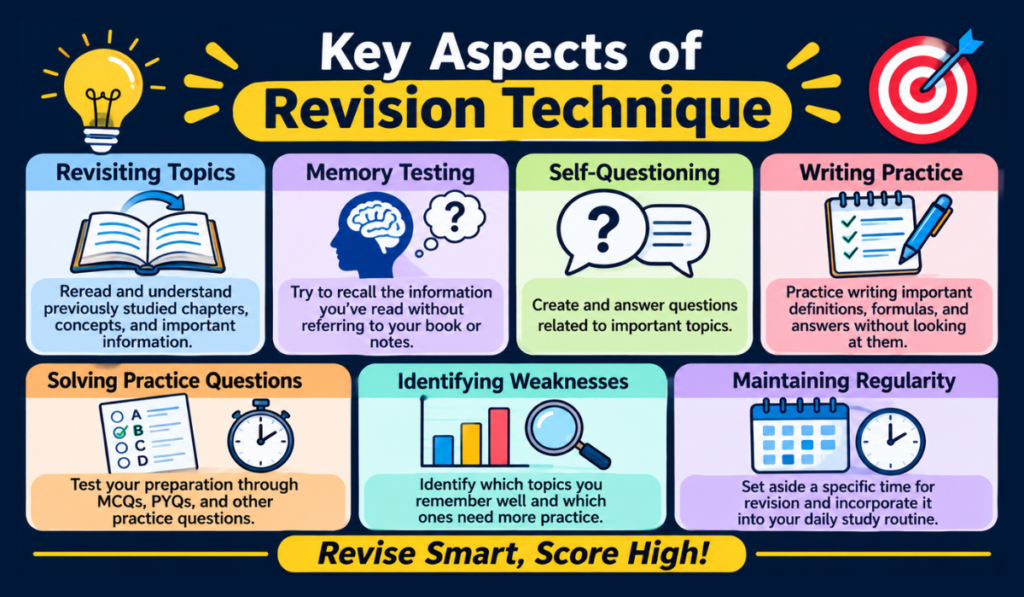
- Revisiting Topics- Reread and understand previously studied chapters, concepts, and important information.
- Memory Testing- Try to recall the information you’ve read without referring to your book or notes.
- Self-Questioning- Create and answer questions related to important topics.
- Writing Practice- Practice writing important definitions, formulas, and answers without looking at them.
- Solving Practice Questions- Test your preparation through MCQs, PYQs, and other practice questions.
- Identifying Weaknesses- Identify which topics you remember well and which ones need more practice.
- Maintaining Regularity- Set aside a specific time for revision and incorporate it into your daily study routine.
Along with good studies, proper revision is also essential. For this, only new reading is not enough, but revising the already read information from time to time is also an important part of effective preparation.
Why is Revision Important in Studies?
Revision plays a crucial role in studies because simply studying a topic once isn’t always enough. Periodic and appropriate revision can help retain the information learned and utilize it effectively during exams.
The key benefits of revision are:
- Strengthening Memory- Regular revision helps retain previously learned concepts, facts, and important information.
- Reducing the Likelihood of Forgetting- Revision at the right time can reduce the difficulty of recalling a topic after a long gap.
- Identifying Weaknesses- Revision helps identify which chapters and concepts are still poorly understood.
- Reducing Exam Stress- Previously revised topics can be easier to recall during exams.
- Increased Self-confidence- Regular revision and self-testing to assess your preparation and practice solving questions increase self-confidence.
So, the purpose of revision is not just to study for longer periods of time, but also to understand, revise, and recall the learned information correctly when needed.
5 Important Principles of Effective Revision-
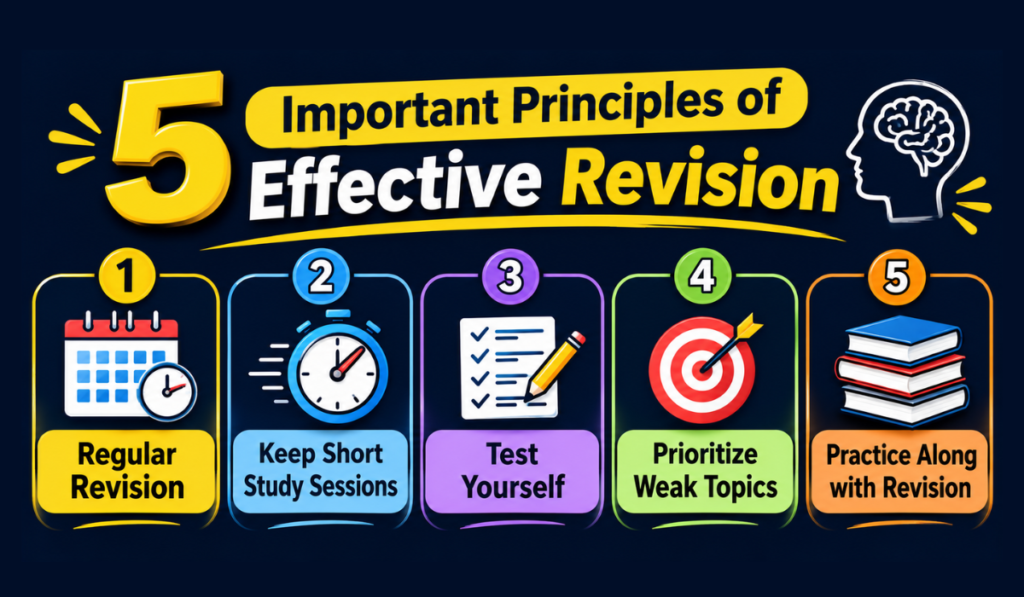
Simply reading repeatedly isn’t enough to make revision effective. It’s important to incorporate some essential principles into your study routine. By revising properly, students can better organize their preparation.
- Regular Revision- After completing a chapter, schedule a revision time in advance. For example, review the topic studied today that day and then the next day.
- Keep Short Study Sessions- Instead of revising for hours at a time, schedule short, focused sessions. This makes it easier to keep your studies organized.
- Test Yourself- Close your book and notes and try to memorize the answers to questions related to the topic you studied. This makes it easier to accurately assess your preparation.
- Prioritize Weak Topics- Take extra time for chapters or topics that you tend to make mistakes in and practice them repeatedly.
- Practice Along with Revision- Don’t limit yourself to just reading notes. Test your ability by solving MCQs, PYQs, numericals, and written questions.
Keep in mind, every student has a different learning ability and study method. So, schedule your revision time and method based on your needs, the syllabus, and exam schedule.
7 Most Effective Revision Techniques for Students-

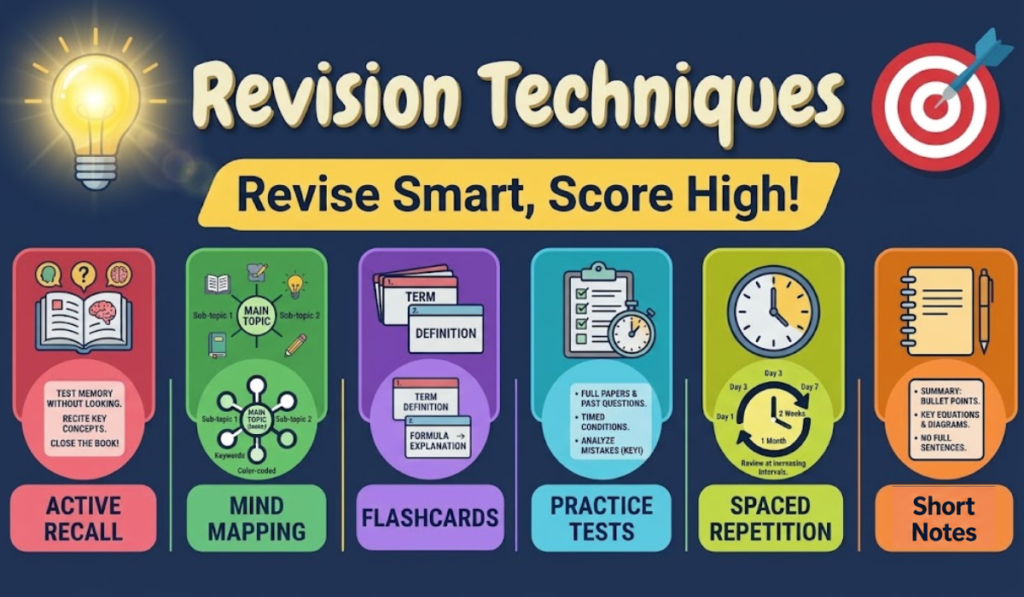
Choosing the right revision technique is crucial for long-term retention of any chapters or topics. Instead of simply reading the book or notes repeatedly, there are some techniques that can help improve memory, understanding, and practice. The following are 7 useful revision techniques for students:
1. Active Recall Technique (Memorizing Without Looking)-
In this technique, you attempt to recall the concepts you’ve studied by closing the book or notes. This reveals how much you actually remember. For example, after reading a chapter in Biology, ask yourself questions related to it and answer them without looking at the book.
2. Spaced Repetition Technique (Repetition at Timed Intervals)-
In this technique, a topic is repeated at different time intervals instead of repeatedly reading it on the same day. For example, revise a chapter the same day, the next day, then three days later, and seven days later. This can help retain information for a longer period.
3. Pomodoro Technique (Studying by Time)-
In this technique, studying is divided into short sessions. For example, study for 25 minutes with concentration and then take a 5-minute break. You can also adjust this time to suit your convenience and concentration.
4. Mind Mapping Technique (Revision through Pictures)-
In this technique, the main concepts and important information of a large chapter are written in the form of diagrams, graphs, or branches, connecting them to a central topic. This can make it easier to understand the concepts of the chapters and revise important points.
5. Flashcards Technique (Question-Answer Cards)-
Flashcards have the question written on one side and the answer on the other. These can be used to memorize definitions, formulas, vocabulary, and important facts. For example, practice regularly by making flashcards of important Chemistry formulas.
6. Practice Testing Technique-
This technique involves assessing your preparation by solving past question papers, mock tests, and chapter-wise tests. This helps you better understand questions, manage your time, and identify mistakes.
7. Feynman Technique-
This technique involves explaining a difficult concept in simple language, as if you were teaching another student. For example, explain a physics law in your own words. Reread the part you find difficult to explain.
According to scientific research, Spaced Practice and Retrieval Practice are considered effective revision techniques for learning. Revising the topics studied at appropriate time intervals and trying to remember concepts and important information without looking at the book can help improve the learning process.
When and How Often Should You Revise Using Spaced Repetition?
Spaced repetition is a revision technique that involves repeating a topic at regular intervals rather than studying it all at once. Its purpose is to help retain the information learned. If you skip a chapter once, you may forget its concepts over time. Therefore, revising at appropriate intervals is crucial. For this, students can follow the revision schedule below.
| Revision | When to Revise? |
|---|---|
| First | On the same day after completing the study |
| Second | The next day |
| Third | After 3 days |
| Fourth | After 7 days |
| Fifth | After 15 days |
| Sixth | After 30 days |
How to Follow This Schedule?
- Do a short revision of a new chapter the same day you finish it.
- Try to memorize key concepts without looking at the book the next day.
- Assess your preparation using questions and notes after 3 and 7 days.
- Practice again after 15 and 30 days to see how much you remember.
Important Tip- This is only an example-based revision schedule, not a mandatory scientific rule. Each student’s learning ability and subject difficulty vary. If you have difficulty remembering a topic, revise it early, while you can keep a little more gap between topics that you remember well.
How to Revise? Step-by-Step Process for Proper Revision-
Simply reading notes isn’t enough for proper revision. It’s essential to follow a systematic process that allows you to assess your preparation and improve weak areas on time. Students can follow the 7 simple steps below to revise any subject or chapter.
| Step | Revision Process | What to Do? |
|---|---|---|
| 1. Choose a Chapter | Select a Subject | Choose the Subject or Chapter you want to revise. Give priority to weak Topics. |
| 2. Recall Without Looking at Notes | Review Previous Information | Close your book or Notes and try to recall the main Concepts, important facts, formulas, and definitions. |
| 3. Compare with Notes | Check Your Knowledge | Compare the Points you recalled with your Notes or textbook. Revisit Concepts you forgot or remembered incorrectly. |
| 4. Solve Important Questions | Practice Questions | Solve MCQs, PYQs, and other practice questions related to the Chapter. |
| 5. Make a List of Mistakes | Error Notebook | Write incorrect answers and difficult Concepts in your Error Notebook. Also, note the reason for each mistake and the correct answer. |
| 6. Revise Again | Practice Weak Topics | Understand incorrect Concepts again and practice related questions after some time. |
| 7. Check Your Progress | Self-Assessment | Take a short Test and check how many questions you answered correctly. Compare your performance with previous practice to assess your preparation. |
Remember, it is also important to assess yourself after completing the revision. This not only tells you how much you have studied, but also helps you understand how well you are able to remember.
Daily Revision Timetable: How Much Time Should Be Allocated to Revision Each Day?
Making revision effective for every student doesn’t mean spending all their time revising previously studied chapters or topics. It’s best to allocate separate time in their daily study routine for studying new topics, revising previously studied chapters, active recall, and solving practice questions. Below is an example-based daily revision routine for students preparing for NEET UG.
| Activity | Time |
|---|---|
| Revision of Previously Studied Chapters | 30 minutes |
| Studying New Topics | 2 hours |
| Active Recall and Notes | 30 minutes |
| Practice Questions | 45 minutes |
| Revision of Mistakes | 15 minutes |
| Total Time | 4 hours |
This timetable is only an example and not mandatory for all students. You can modify it according to your studies, school, coaching, and other responsibilities. The most important thing is that revision should not be considered only as a pre-exam schedule, but it should be made a regular part of daily studies.
How to Revise Before Exams?
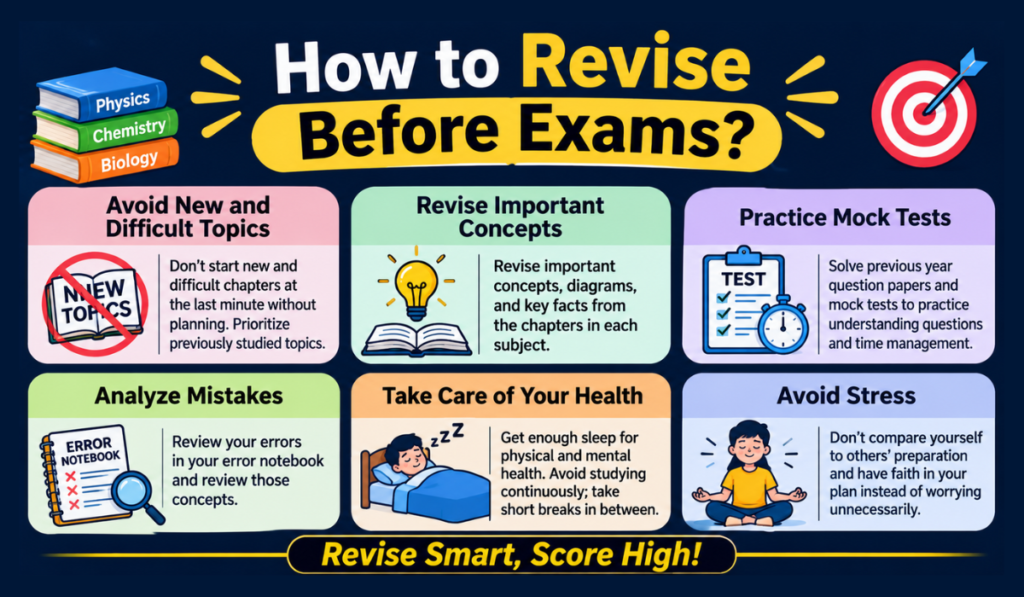
Adopting the right revision techniques or strategy is crucial during the final days of exams. Instead of panicking, students should focus on strengthening the chapters they’ve already studied. To achieve this, keep a few things in mind:
- Avoid New and Difficult Topics- Don’t start new and difficult chapters at the last minute without planning. Prioritize previously studied topics.
- Revise Important Concepts- Revise important concepts, diagrams, and key facts from the chapters in each subject.
- Practice Mock Tests- Solve previous year question papers and mock tests to practice understanding questions and time management.
- Analyze Mistakes- Review your errors in your error notebook and review those concepts.
- Take Care of Your Health- Get enough sleep for physical and mental health. Avoid studying continuously; take short breaks in between.
- Avoid Stress- Don’t compare yourself to others’ preparation and have faith in your plan instead of worrying unnecessarily.
Remember, last-minute revision is meant to consolidate the hard work already done, not to start the entire preparation from scratch.
Common Mistakes Students Make While Revising-
Despite regular study and revision, most students fail to fully benefit from their studies. One reason for this could be some common mistakes made during revision.
- Reading Only Notes- Repeatedly reading notes without testing yourself doesn’t reveal your true preparation. Therefore, practice active recall to revise.
- Procrastinating Revision- Not revising old chapters until the exam is near can lead to forgetting important things.
- Studying Too Much in a Single Day- Revision for long periods without breaks can lead to fatigue.
- Skipping Weak Topics- Instead of avoiding difficult chapters, try to understand and practice them.
- Ignoring Mistakes- It’s not advisable to proceed without understanding the reason behind incorrect answers.
- Studying Without Planning- Determine the revision time and topics in advance. By correcting these mistakes, you can make your revision strategy more systematic and effective.
Useful Digital Tools and Apps for Revision-
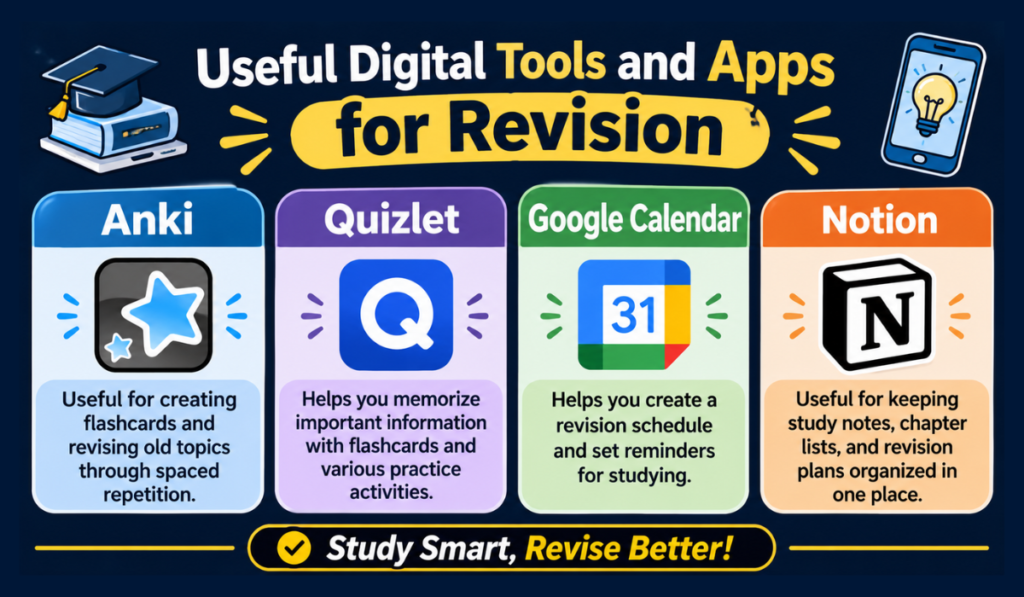
These days, many digital tools are available to students that can help them organize their revision techniques or strategies. Some of these useful tools and apps are as follows:
- Anki- Useful for creating flashcards and revising old topics through spaced repetition.
- Quizlet- Helps you memorize important information with flashcards and various practice activities.
- Google Calendar- Helps you create a revision schedule and set reminders for studying.
- Notion- Useful for keeping study notes, chapter lists, and revision plans organized in one place.
Although using these apps is not mandatory, students can also adopt good revision techniques using a simple notebook, calendar, and paper flashcards. The key is regular practice and timely revision.
Example: How to Revise a Chapter?
Suppose a student has completed a chapter of Physics. That very day, he closes the book and tries to memorize its main concepts. After this, he compares his answers with NCERT, notes the missing points, and solves MCQs.
The next day, he solves the questions of the same chapter again. Three days later, he takes a short test of that chapter and writes down the wrong questions in his error notebook. After a week, he practices the entire chapter again.
In this way, by dividing the revision into small steps, one can make his studies organized and effective.
Frequently Asked Questions (FAQs) about Revision Techniques-
How long after studying should one revise?
After completing a topic or chapter, it can be useful to do a short 10-15-minute revision the same day. Repeat it the next day, and then every few days. This can help you retain the information you’ve learned and test your abilities.
How many hours should one revise daily?
No fixed time applies to all students for revision. It depends on your ability, the syllabus, school or coaching schedules, and exam preparation. Set aside 30 minutes or more depending on your daily routine and maintain regularity.
What is Active Recall?
Active Recall is a revision technique in which students attempt to recall information and answer questions without referring to a book or notes. This helps students assess their memory and understanding of the subject.
Is revision from notes alone sufficient?
No, simply reading notes is not enough. They should be supplemented with MCQs, PYQs, self-testing, and error analysis. This helps you understand how much you truly understand a topic.
How to revise before the exam?
Prioritize important concepts, formulas, NCERT topics, and weak chapters before the exam. Practice mock tests and previous year question papers regularly. Also, get adequate sleep and avoid unnecessary stress so that you can solve questions with better concentration during the exam.
Conclusion-
Simply studying new topics isn’t enough for effective preparation; it’s equally important to revise previously studied topics at the right time. Regular revision can help students assess their understanding, identify their weaknesses in related subjects, and organize their exam preparation.
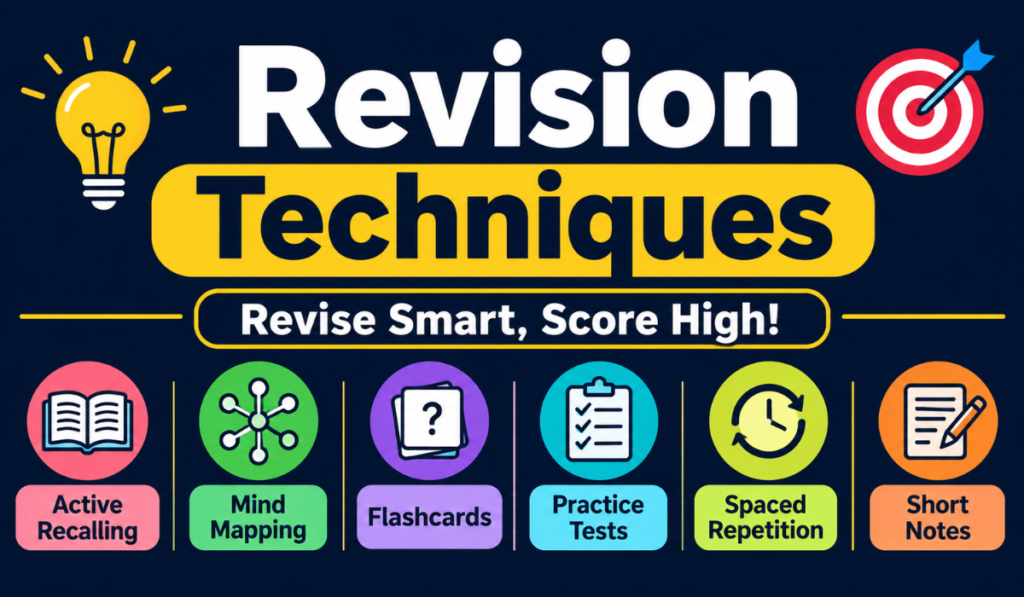
Revision techniques like Active Recall, Spaced Repetition, Practice Testing, and Subject-wise Revision can help make studying more effective. While every student’s needs and learning abilities vary, create a revision plan based on your convenience, the syllabus, and the exam schedule. The most important thing is to make revision a regular part of your studies and keep learning from your mistakes.
Be sure to incorporate this revision technique into your daily study routine and continue practicing regularly. If you find this blog helpful, share it with your friends so they can also make their studies more effective.